
Posted by Tom Fischer on Jun 1st 2026
Understanding Modern Concrete Mixes: 20 Years of Evolution from Traditional Concrete to UHPC
The Evolution of Concrete Mix Design
Concrete has been used for thousands of years, but today's concrete bears little resemblance to the simple mixtures used in the past. Modern concrete technology has evolved far beyond cement, sand, stone, and water. Through advancements in material science, engineers and fabricators now have access to specialized mix designs capable of producing stronger, denser, more durable, and more aesthetically refined concrete than ever before.
Whether you're pouring a sidewalk, casting a countertop, creating architectural panels, or producing advanced precast elements, choosing the right mix design is critical to success.
At Fishstone, we work with fabricators, contractors, artists, and manufacturers across North America who use everything from traditional high-performance concrete to GFRC, ECC-inspired mixes, and advanced particle-packed casting systems. Recent developments such as particle-packed casting technologies, including systems like UltraCast 360, have made advanced concrete materials more accessible than ever before. If you're looking for specific formulations, be sure to visit our Concrete Mix Recipe Library, where we share proven mix designs and techniques for decorative and architectural concrete applications.
Twenty Years of Sharing Concrete Mix Design Knowledge
When Fishstone first entered the decorative concrete industry nearly 20 years ago, information on advanced concrete mix design was difficult to find. Many manufacturers treated their formulas as closely guarded secrets, and very few resources existed for fabricators looking to understand the science behind concrete.
One of our goals from the beginning was to help educate the industry by openly sharing mix recipes, material recommendations, and technical information. In fact, Fishstone was among the first companies to publicly publish detailed mix designs for technologies such as High-Performance Concrete (HPC), Glass Fiber Reinforced Concrete (GFRC), and other advanced cementitious systems used throughout the decorative concrete industry today.
Over the years, these technologies have become more refined, and new materials such as ECC and UHPC have become increasingly accessible. While the materials continue to evolve, our commitment to education remains the same. This article provides an overview of the most common concrete mix technologies used today, along with example mix designs and the material science principles that make each system unique.
Why Mix Design Matters
The performance of concrete is determined not only by the quality of its ingredients, but also by how those ingredients interact. Water-cement ratio, aggregate gradation, supplementary cementitious materials, fibers, polymers, and chemical admixtures all influence strength, durability, workability, and long-term performance.
Two concrete mixes may appear similar on paper while producing dramatically different results in practice. Understanding the principles behind mix design allows fabricators to select the right materials and techniques for their specific application.
Conventional Concrete Mixes
What They Are
Conventional concrete mixes are the foundation of modern construction. Most ready-mix and bagged concrete products consist of Portland cement, sand, coarse aggregate, and water. While these mixes are economical and effective for structural work, they were never designed for the demands of modern decorative concrete.
Typical Properties
| Property | Typical Value |
|---|---|
| Compressive Strength | 3,000 – 5,000 PSI |
| Flexural Strength | 400 – 700 PSI |
| Durability | Moderate |
| Surface Quality | Basic |
| Cost | Low |
Advantages
-
Economical
-
Widely available
-
Easy to use
-
Excellent for slabs, footings, and structural work
Limitations
-
Limited flexural strength
-
Larger aggregate restricts thin sections
-
More prone to shrinkage cracking
-
Greater porosity
-
Less refined surface finish
High-Performance Concrete (HPC)
What Is High-Performance Concrete?
High-Performance Concrete focuses on improving durability, density, workability, and long-term performance through advanced mix design.
Unlike conventional concrete, HPC utilizes supplementary cementitious materials and specialty admixtures to reduce permeability and increase strength.
Typical Ingredients
-
Portland Cement
-
Fine aggregates
-
Metakaolin
-
Silica Fume
-
High-range water reducers
-
Specialty fibers
Typical Properties
| Property | Typical Value |
|---|---|
| Compressive Strength | 6,000 – 12,000 PSI |
| Flexural Strength | 800 – 1,500 PSI |
| Durability | High |
| Permeability | Low |
Example Mix Design
Super-Six Admix combines polymer technology, shrinkage reduction, water repellency, dispersion aids, and workability enhancement into a single additive package. This allows fabricators to create dense, durable concrete with improved strength and reduced cracking potential.
Common Applications
-
Countertops
-
Furniture
-
Fireplace surrounds
-
Architectural castings
-
Specialty precast products
Engineered Cementitious Composite (ECC)
What Is ECC?
Engineered Cementitious Composite (ECC), often called "bendable concrete," is one of the most advanced developments in cement-based materials.
Rather than forming a few large cracks, ECC distributes stresses through thousands of microscopic cracks, dramatically increasing ductility and toughness.
How ECC Works
ECC formulations typically contain:
-
Cement
-
Fine silica sand
-
Metakaolin
-
Specialty admixtures
-
PVA fibers
Most ECC systems eliminate coarse aggregate entirely.
Typical Properties
| Property | Typical Value |
|---|---|
| Compressive Strength | 8,000 – 12,000 PSI |
| Tensile Strain Capacity | Up to 5% |
| Crack Width | Less than 0.1 mm |
| Ductility | Extremely High |
Example Mix Design
-
Portland Cement
-
Fine Silica Sand
In this application, Super-Six Admix supports ECC principles by improving particle dispersion, reducing shrinkage, enhancing durability, and improving workability at low water-cement ratios.
Common Applications
-
Thin architectural panels
-
Crack-resistant precast products
-
Impact-resistant components
-
Seismic applications
-
Specialty decorative concrete
Glass Fiber Reinforced Concrete (GFRC)
What Is GFRC?
GFRC uses alkali-resistant glass fibers as the primary reinforcement mechanism. Rather than relying on steel reinforcing bars, millions of individual glass filaments provide tensile and flexural strength throughout the concrete matrix.
This allows fabricators to produce durable sections as thin as ½ inch.
Typical Ingredients
-
Portland Cement
-
Fine Silica Sand
-
Polymer
-
Water
-
AR Glass Fibers
Typical Properties
| Property | Typical Value |
|---|---|
| Compressive Strength | 8,000 – 15,000 PSI |
| Flexural Strength | 2,000 – 4,000 PSI |
| Typical Thickness | ½" – 1" |
| Weight | Significantly lighter than conventional concrete |
Example Mix Design
-
Portland Cement
-
Fine Silica Sand
KongKrete Polymer improves flexural strength, adhesion, durability, and curing characteristics while AR Glass Fibers provide the primary structural reinforcement.
Common Applications
-
Concrete countertops
-
Furniture
-
Fireplace surrounds
-
Outdoor kitchens
-
Architectural panels
-
Wall cladding
Ultra-High Performance Concrete (UHPC)
What Is UHPC?
UHPC represents the highest level of commercially available concrete technology.
Rather than relying on large aggregate particles, UHPC uses advanced particle-packing theory, carefully selecting particle sizes from the micron scale upward to maximize density and minimize internal voids.
Unlike conventional concrete, UHPC derives much of its performance from particle optimization and matrix density rather than simply increasing cement content.
The result is exceptional strength, durability, and surface quality.
Typical Ingredients
-
Portland Cement
-
Silica Fume
-
Metakaolin
-
Fine Quartz Sand
-
Fibers
-
High-range water reducers
-
Specialty pozzolans
Typical Properties
| Property | Typical Value |
|---|---|
| Compressive Strength | 18,000 – 30,000+ PSI |
| Flexural Strength | 3,000 – 8,000 PSI |
| Permeability | Extremely Low |
| Durability | Exceptional |
Example Mix Design
-
Additional fiber reinforcement as required
UltraCast 360 incorporates many of the same particle-packing concepts used in modern UHPC technology. Carefully graded materials ranging from approximately 1 micron to 500 microns create an exceptionally dense matrix with minimal void space, resulting in outstanding surface quality, reduced pinholes, high durability, and excellent strength.
Common Applications
-
Countertops
-
Furniture
-
Architectural panels
-
High-definition castings
-
Thin-shell structures
-
Specialty precast products
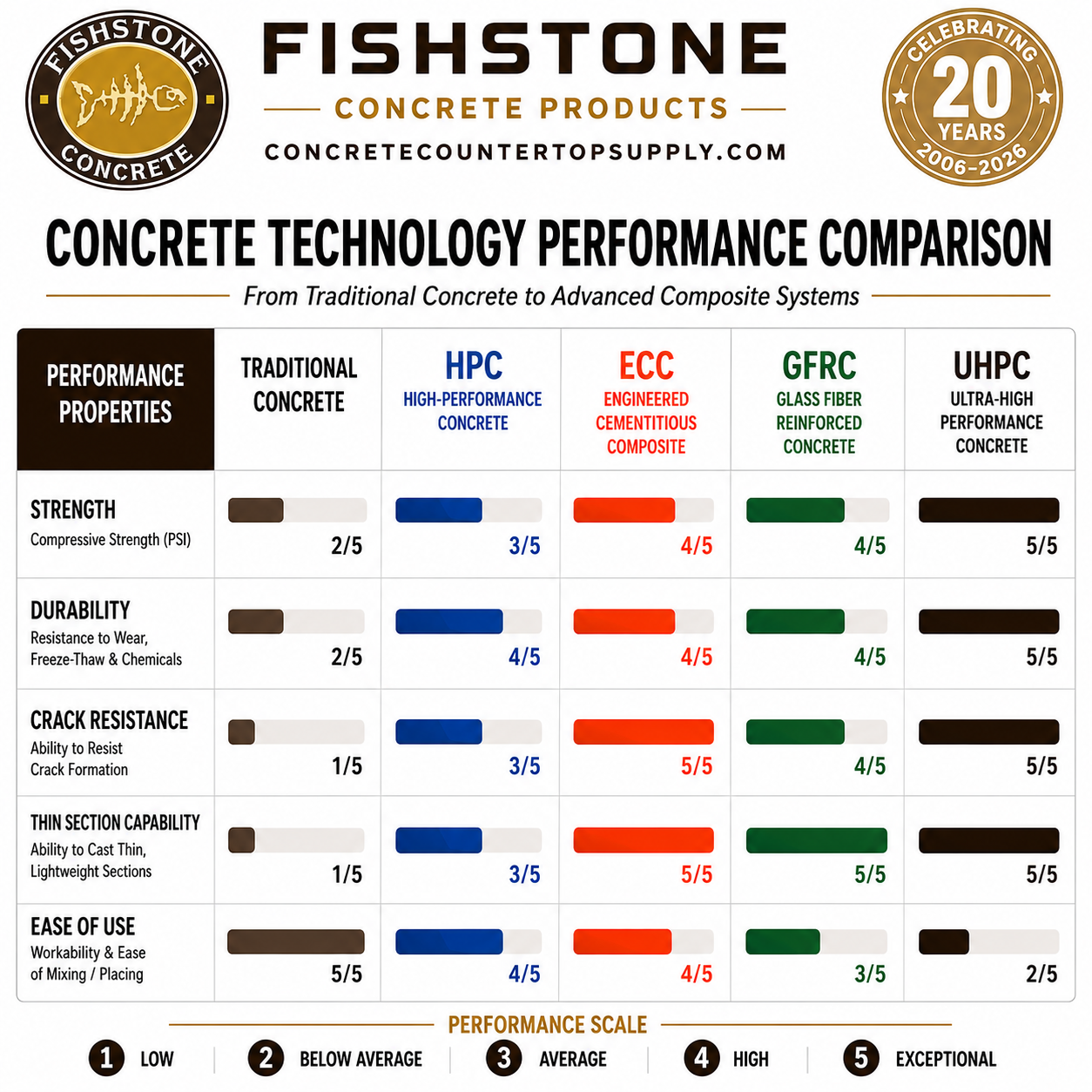
Comparing Modern Concrete Mix Technologies
Which Mix Is Right for Your Project?
There is no single "best" concrete mix—only the best mix for a specific application.
-
Conventional concrete is ideal for basic construction projects.
-
HPC provides improved durability and aesthetics for decorative applications.
-
ECC offers unmatched crack resistance and ductility.
-
GFRC excels in lightweight, thin-section fabrication.
-
UHPC provides the highest levels of strength, density, and durability available today.
Modern decorative concrete often borrows concepts from all of these technologies. The most successful fabricators understand not only how to use these systems, but why they work.
At Fishstone, our product line is designed to support every level of concrete fabrication—from traditional high-performance concrete to advanced GFRC, ECC-inspired systems, and UHPC-style particle-packed mixes.
Whether you're casting your first countertop or producing advanced architectural concrete, understanding the science behind mix design is the first step toward creating stronger, more durable, and more beautiful concrete.
For nearly two decades, Fishstone has been committed to sharing the science behind concrete mix design. Whether you're exploring traditional high-performance concrete, GFRC, ECC-inspired systems, or modern UHPC technology, understanding how these materials work is the key to producing stronger, more durable, and more beautiful concrete.
For detailed recipes and formulations, visit our Concrete Mix Recipe Library. Many of the mix designs published there have been refined through years of testing, fabrication, and real-world use by concrete artisans, contractors, and manufacturers throughout North America.