
May 22nd 2026
The Science Behind Ultra-Dense Concrete
The Science Behind Ultra-Dense Concrete
How Advanced Particle Packing and UltraCast® 360 Are Redefining Modern Architectural Concrete
Concrete has come a long way from the rough, porous material traditionally associated with sidewalks and foundations. In the world of architectural concrete, GFRC, ECC, UHPC, and artisan precast work, today’s most advanced mixes are engineered to be ultra-dense, highly refined materials capable of producing exceptional strength, durability, and surface quality.
At Fishstone, this philosophy helped drive the development of UltraCast® 360, a next-generation ultra-dense concrete system specifically engineered to produce exceptionally refined surfaces, improved detail reproduction, and dramatically reduced surface porosity — especially in complex 3D castings where traditional mixes often struggle.
But what exactly makes concrete “ultra-dense,” and why does it matter?
Understanding Concrete Density
At its core, concrete is a composite material made from:
- Cement
- Aggregates
- Water
- Admixtures
- Pozzolans
- Fibers (in many high-performance systems)
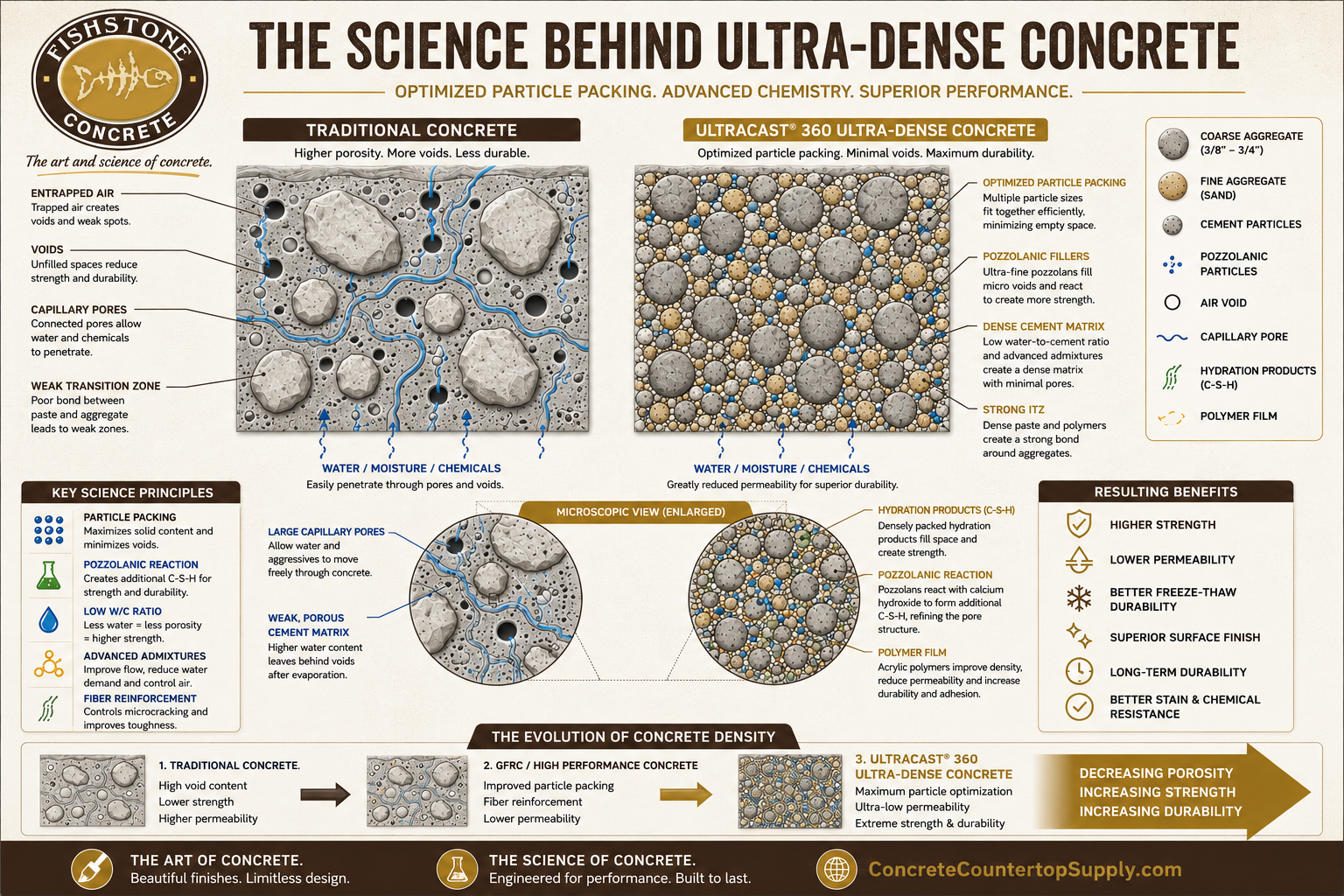
Traditional concrete often contains microscopic voids, capillaries, and weak transition zones between the cement paste and aggregates. These internal imperfections reduce strength and allow water, air, and contaminants to penetrate the material over time.
Ultra-dense concrete is engineered specifically to minimize these weaknesses.
The goal is simple:
Reduce internal void space while maximizing particle packing and cement hydration.
The result is a concrete that is:
- Stronger
- More durable
- Less porous
- More stain resistant
- More freeze-thaw resistant
- Capable of producing smoother, more refined surfaces
This pursuit of density and refinement is exactly what inspired the development of UltraCast® 360 Ultra-Dense Concrete at Fishstone.
UltraCast® 360: Engineering Concrete at the Microscopic Level
Traditional concrete mixes often rely on relatively broad ingredient ranges and conventional aggregate structures. While effective for basic applications, these mixes can struggle when producing highly refined architectural castings with minimal surface defects.
UltraCast® 360 was engineered differently.
Rather than focusing solely on compressive strength, UltraCast® 360 was designed around:
- Advanced particle packing
- Surface refinement
- Reduced porosity
- Rheology control
- Air management
- Enhanced casting performance
The system utilizes a carefully balanced gradation of materials ranging from ultra-fine pozzolans and cement particles to larger aggregate structures. By optimizing how these particles fit together, UltraCast® 360 minimizes empty space within the concrete matrix.
The result is an ultra-dense concrete capable of producing:
- Sharper details
- Smoother finishes
- Fewer pinholes
- Reduced bugholes
- Improved durability
- Lower permeability
- Exceptional surface consistency
Especially in:
- 3D castings
- Decorative concrete
- Concrete sinks
- Furniture
- Fire features
- Architectural panels
- Complex molds with undercuts and returns
Particle Packing: The Foundation of Ultra-Dense Concrete
One of the most important principles behind ultra-dense concrete is particle packing.
In traditional concrete, the particle sizes are often poorly optimized, leaving empty spaces between larger materials. These gaps require additional cement paste and water to fill them, which can increase shrinkage and porosity.
UltraCast® 360 instead utilizes a precision-engineered blend of particles spanning multiple sizes to maximize density and reduce void space.
Think of it like filling a jar:
- Large particles leave large gaps
- Sand fills some of those gaps
- Fine powders fill even smaller gaps
- Ultra-fine pozzolans fill microscopic voids
The more efficiently those particles fit together, the denser the concrete becomes.
This optimized particle packing is one of the primary reasons UltraCast® 360 produces such refined, high-definition surfaces with dramatically reduced surface defects compared to traditional concrete systems.
Why Pozzolans Matter
Pozzolans play a major role in ultra-dense concrete technology and are heavily utilized within advanced systems like UltraCast® 360.
Materials such as:
- Silica fume
- Metakaolin
- Fly ash
- Ultra-fine mineral admixtures
react with calcium hydroxide produced during cement hydration.
This secondary reaction creates additional calcium silicate hydrate (C-S-H), which is the primary compound responsible for concrete strength.
Benefits include:
- Reduced porosity
- Increased density
- Improved strength
- Reduced permeability
- Improved surface refinement
- Enhanced durability
Ultra-fine pozzolans also help fill microscopic voids within the cement matrix, further tightening the structure of the concrete.
In UltraCast® 360, this optimized chemistry contributes not only to strength and durability, but also to the smooth, refined surface appearance highly desired in decorative and architectural concrete applications.
Air Management and Surface Refinement
One of the greatest challenges in decorative concrete is trapped air.
Entrapped air creates:
- Pinholes
- Surface voids
- Bugholes
- Weak spots
- Inconsistent finishes
This problem becomes especially severe in:
- Deep molds
- Vertical castings
- Complex geometry
- Detailed textures
- Undercuts
Traditional free-flowing mixes often allow air to migrate and become trapped beneath overhangs and intricate mold details.
UltraCast® 360 was specifically engineered to improve air release and surface refinement through:
- Optimized rheology
- Improved particle gradation
- Advanced admixture chemistry
- Enhanced flow behavior
- Better surface wetting characteristics
The goal is not simply stronger concrete —
it is stronger concrete with dramatically improved casting quality.
For many artisans and fabricators, reducing surface defects means:
- Less slurry filling
- Less grinding
- Less patching
- Less polishing
- Faster production
- More consistent results
Lower Water Demand = Higher Density
Water is necessary for cement hydration, but excess water is one of the biggest enemies of dense concrete.
As excess water evaporates, it leaves behind capillary pores and microscopic voids.
UltraCast® 360 utilizes advanced admixture technology and optimized particle packing to maintain excellent workability while minimizing unnecessary water demand.
This allows the concrete to:
- Flow efficiently
- Fill molds thoroughly
- Maintain excellent casting performance
- Achieve high density
- Reduce shrinkage
- Improve durability
Modern superplasticizers such as P-120 Superplasticizer can further enhance these properties when designing advanced high-performance concrete systems.
The Role of Acrylic Polymers
Modern high-performance concrete systems frequently incorporate acrylic polymers to improve both fresh and hardened concrete properties.
High-quality acrylic polymers can:
- Improve flexural strength
- Increase adhesion
- Reduce permeability
- Improve curing
- Enhance workability
- Reduce cracking
- Improve pigment dispersion
- Increase density
In advanced GFRC systems, polymers also help improve long-term durability while reducing reliance on extended wet curing.
Products like KongKrete GFRC Polymer are specifically engineered to complement high-performance systems like UltraCast® 360.
Why Ultra-Dense Concrete Matters
Ultra-dense concrete systems like UltraCast® 360 represent a major evolution in decorative and architectural concrete technology.
Benefits include:
- Reduced pinholes
- Superior detail reproduction
- Higher density
- Lower permeability
- Improved polishability
- Better stain resistance
- Enhanced freeze-thaw durability
- Greater consistency
- Reduced post-processing
For fabricators, this means:
Better surfaces. Faster production. More reliable results.
For designers and clients, it means concrete that looks more refined, performs better, and lasts longer.
The Future of Architectural Concrete
Modern high-performance concrete is no longer simply “strong concrete.”
It is engineered material science.
Today’s advanced systems combine:
- Precision particle packing
- Pozzolanic chemistry
- Advanced admixture technology
- Polymer science
- Fiber reinforcement
- Rheology control
to produce concrete that is dramatically different from traditional mixes used just a few decades ago.
UltraCast® 360 represents this next generation of concrete technology — a system engineered not just for strength, but for refinement, consistency, durability, and exceptional casting performance.
As architectural concrete continues evolving, the future belongs to ultra-dense systems capable of delivering both structural performance and extraordinary surface quality.
At Fishstone, we believe that future is already here.