

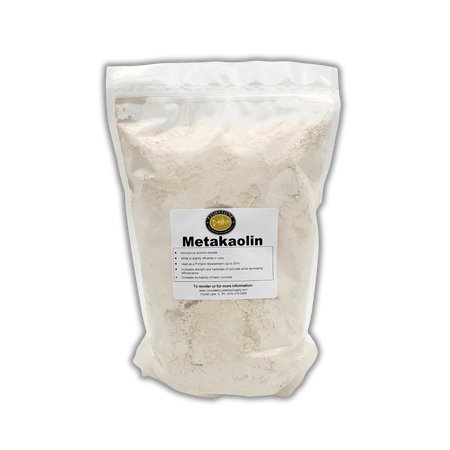

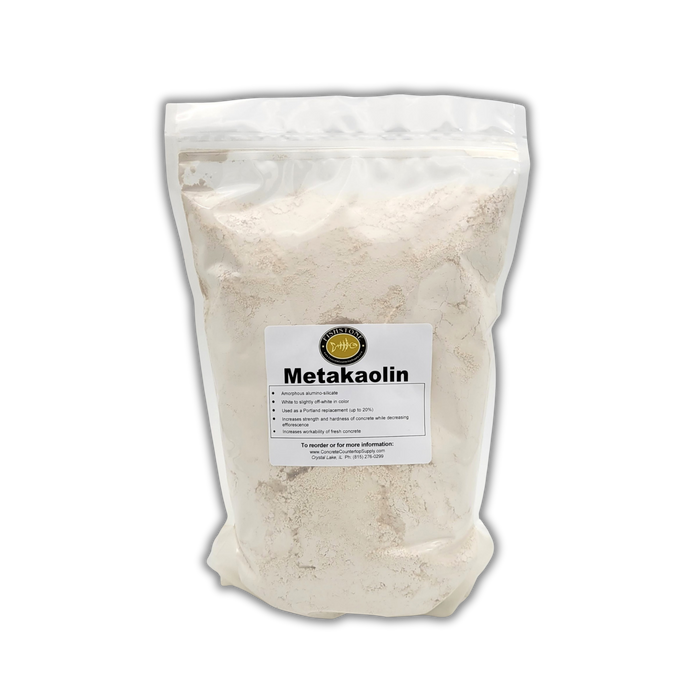
Metakaolin – High Reactivity White Pozzolan
$76.50
HIGH-PERFORMANCE CONCRETE TECHNOLOGY
High Reactivity Metakaolin
Premium White Pozzolan for GFRC, UHPC, Concrete Countertops & Sculpting Mixes
High Reactivity Metakaolin (HRM) is a premium, ultra-fine, white pozzolanic mineral admixture engineered to improve the strength, density, durability, workability and surface quality of Portland cement-based materials.
Manufactured from carefully selected and thermally activated kaolin clay, metakaolin combines exceptional pozzolanic reactivity with fine particle packing to produce a stronger, denser and less permeable cementitious matrix.
Ideal for glass fiber reinforced concrete (GFRC), concrete countertops, ultra-high performance concrete (UHPC), architectural precast, concrete sculpture, vertical carving mortars and decorative concrete, metakaolin delivers meaningful performance improvements without the dark coloration commonly associated with silica fume.
Beyond its strength and durability benefits, metakaolin is particularly valuable in specialty sculpting and carving mixes. Its influence on fresh-mix rheology can create a cohesive, clay-like consistency that improves shape retention, reduces sagging and supports detailed hand-forming.
Our high-reactivity metakaolin is manufactured by Advanced Cement Technologies under the PowerPozz brand.
High-Performance Pozzolanic Technology
5–15%
Cement Replacement
Typical dosage by weight
ASTM C618
Class N Pozzolan
Manufacturer classification
1.5 µm
Fine Particle Size
Reported property average
White
Architectural Grade
Cream-white appearance
Engineered for Exceptional Concrete Performance
Metakaolin improves cementitious materials through both chemical pozzolanic activity and physical particle packing. Together, these mechanisms enhance the hardened cement matrix while influencing the cohesion and rheology of fresh concrete and mortar.
Increased Strength
Promotes additional cementitious hydration products, improving compressive strength and supporting enhanced flexural performance.
Reduced Permeability
Refines the cement paste pore structure and reduces interconnected capillary pathways, limiting moisture and contaminant penetration.
Efflorescence Control
Consumes free calcium hydroxide and reduces moisture transport, helping minimize white mineral deposits on architectural surfaces.
Improved Durability
Can improve resistance to chloride penetration, certain aggressive exposure conditions and alkali-silica reaction (ASR).
Enhanced Cohesion & Shape Retention
Can increase paste body and yield stress, helping properly formulated sculpting and carving mortars resist slump and sag.
Superior Architectural Finish
Fine particles and cream-white coloration support dense, smooth finishes and consistent pigmentation in decorative concrete.
The Science Behind High Reactivity Metakaolin
Metakaolin is produced through controlled thermal activation of kaolin clay. Calcination removes structural hydroxyl groups from kaolinite, transforming the crystalline mineral into a highly reactive, largely amorphous aluminosilicate.
During Portland cement hydration, calcium silicate phases react with water to form calcium silicate hydrate (C-S-H), the primary strength-producing hydration product, along with calcium hydroxide (Ca(OH)2), also called portlandite or free lime.
The reactive silica (SiO2) and alumina (Al2O3) in metakaolin react with calcium hydroxide to form additional calcium silicate hydrate (C-S-H), calcium aluminosilicate hydrate (C-A-S-H) and related calcium aluminate hydration products.
POZZOLANIC REACTION
Metakaolin + Calcium Hydroxide + Water
↓
Additional Cementitious Hydration Products
Increased Paste Density • Reduced Porosity • Improved Strength
Two Mechanisms. One Stronger Matrix.
1. Chemical Pozzolanic Reaction: Reactive aluminosilicates consume calcium hydroxide and generate additional cementitious hydration products, refining the matrix and improving durability.
2. Physical Particle Packing: Fine metakaolin particles occupy spaces between larger cement grains, improving particle distribution and reducing porosity within the hardened paste.
These effects work together to produce a dense, durable cementitious binder suitable for demanding structural, architectural and decorative applications.
Where Metakaolin Performs Best
From high-performance structural materials to artistic concrete applications, metakaolin is a versatile mineral admixture that can improve both fresh-mix properties and hardened concrete performance.
Premix & Spray-Up GFRC
Improves matrix density, strength and durability in glass fiber reinforced concrete, including thin-section architectural products.
GFRC Face Coats
Supports smooth architectural finishes, color consistency and reduced moisture-related discoloration.
Concrete Countertops & Sinks
Ideal where surface density, low permeability, efflorescence resistance and decorative appearance are important.
Concrete Sculpting & Carving
Contributes to cohesive, clay-like mortar consistency, improved buildability and reduced sag in vertical sculpting applications.
UHPC & High-Strength Concrete
Reactive aluminosilicate component for engineered binder systems, low water-to-binder ratios and optimized particle packing.
Architectural Precast & Repair
Suitable for architectural panels, decorative castings, specialty mortars, grouts and cementitious repair materials.
SPECIALTY APPLICATION
Metakaolin for Concrete Sculpting & Carving Mixes
Clay-Like Workability. Improved Shape Retention. Exceptional Detail.
Metakaolin is an excellent ingredient to consider when formulating concrete sculpting mixes, vertical carving mortars, artificial rock, architectural reliefs, decorative overlays and hand-formed cement sculptures.
Its ultra-fine particle size and influence on fresh-mix rheology can help create a cohesive, clay-like working consistency. This allows properly formulated cementitious mortars to be shaped, built up and detailed while reducing unwanted slump, sagging and deformation.
Unlike conventional flowing concrete mixes, sculpting mortars require sufficient body to hold their shape during application. Metakaolin can increase a mixture's yield stress and structural build-up, helping it resist gravity and maintain detailed forms before hardening.
Advantages for Sculpting & Carving Mortars
Clay-Like Consistency
Increases paste body and cohesion, supporting a moldable consistency for sculpting, shaping and hand-forming intricate designs.
Reduced Slump & Sag
Can increase static yield stress, helping properly proportioned mortar resist deformation on vertical and irregular surfaces.
Improved Buildability
Supports layered mortar applications, raised textures, artificial rock formations and three-dimensional sculptural details.
Enhanced Detail Retention
Helps formed edges, contours and textures resist deformation as the mortar develops sufficient stiffness to support its shape.
Technical Insight: Thixotropy & Shape Retention
Metakaolin can improve the thixotropic characteristics of cementitious materials. Thixotropy describes time-dependent structural breakdown under shear and rebuilding of that structure once the material is at rest.
For sculpting and carving mortars, this behavior can help create a material that is workable during mixing and manipulation but develops resistance to movement after placement. Research involving metakaolin-modified 3D-printable concrete has demonstrated increased yield stress, structural build-up and shape retention, providing a technical basis for its use in specialty sculpting formulations.
Formulating a Clay-Like Concrete Sculpting Mix
Achieving a carvable, non-sag mortar requires balancing cohesion, yield stress, working time and ease of shaping. Metakaolin can contribute to these properties by increasing paste body and influencing the rheological behavior of the cementitious matrix.
For initial sculpting mortar trials, 8–12% metakaolin replacement of Portland cement by weight is a reasonable experimental range for evaluating workability, cohesion and shape retention.
The final consistency also depends on fine aggregate gradation, water content and admixture selection. Compatible acrylic polymers, cellulose-based rheology modifiers and reinforcing fibers may further improve adhesion, handling and resistance to sagging.
These characteristics make metakaolin a useful ingredient for hand-carved concrete, faux rock, vertical concrete sculpture, themed environments, architectural ornamentation, relief work and decorative cementitious overlays.
Formulation Note: Metakaolin is not a complete carving system or a substitute for proper mix design. The ideal consistency, working time, carving window, application thickness and shape retention must be established through trial batching. Research on extrusion and 3D-printable mortars supports the rheological benefits, but hand-carving performance is formulation-specific.
Recommended Metakaolin Dosage
High-reactivity metakaolin is generally used at 5–15% replacement of Portland cement by weight. The optimum dosage depends on cement chemistry, water-to-cementitious materials ratio (w/cm), target performance, rheological requirements and admixture compatibility.
EXAMPLE: 10% CEMENT REPLACEMENT
90 lb
Portland Cement
+
10 lb
Metakaolin
= 100 lb Total Cementitious Binder
Cement replacement is calculated by weight, not by volume.
Choosing the Right Replacement Rate
| Replacement | Formulation Considerations |
|---|---|
| 5% | Moderate pozzolanic enhancement and initial performance evaluation. |
| 8% | Manufacturer-identified efficient dosage for reaction with available calcium hydroxide. |
| 10% | Practical starting point for trials targeting strength, density, durability and mix cohesion. |
| 12–15% | Higher replacement range for demanding durability, GFRC and specialty mortar applications, subject to mix optimization. |
Dosages are formulation starting points rather than guaranteed optimum levels. Trial batching and performance testing are recommended.
Metakaolin in GFRC & High-Performance Mix Designs
In GFRC and architectural concrete, metakaolin influences both the fresh mix and the hardened cementitious matrix. Its fine particle size can improve cohesion and paste quality, while pozzolanic activity reduces free calcium hydroxide and improves matrix density.
These characteristics are especially useful in thin-section castings, detailed molds and applications requiring a combination of attractive surface finishes and long-term durability.
Mix Design Recommendations
- Replace a portion of Portland cement by weight rather than adding metakaolin without accounting for the total binder content.
- Begin general performance trials around 8–10% cement replacement and optimize based on the application.
- For sculpting and carving mortar trials, consider evaluating 8–12% replacement while monitoring shape retention and workability.
- Disperse metakaolin thoroughly with other cementitious powders to minimize agglomeration.
- Maintain a controlled water-to-cementitious materials ratio (w/cm).
- Adjust compatible polycarboxylate ether (PCE) or other high-range water-reducing admixtures as needed to maintain proper flow.
- For non-sag applications, optimize the complete rheology system rather than relying on metakaolin alone.
- Evaluate compatibility with acrylic polymers, pigments, reinforcing fibers and other supplementary cementitious materials.
- Monitor workability, setting characteristics, entrained air, surface appearance and strength development.
- Follow appropriate curing procedures to support continued cement hydration and pozzolanic activity.
Technical Note: Water Demand & Rheology
Because of its fine particle size and surface characteristics, metakaolin can influence water demand, viscosity, yield stress and thixotropy. For flowing GFRC and high-performance concrete, use compatible water-reducing admixtures to achieve the desired consistency. For sculpting and non-sag mortars, optimize these same characteristics to retain shape while maintaining a workable material.
Metakaolin vs. Silica Fume
Metakaolin and silica fume are both highly reactive supplementary cementitious materials used to increase strength and durability. However, their chemistry, particle characteristics and coloration differ, making metakaolin particularly attractive for architectural and decorative concrete.
| Characteristic | Metakaolin | Silica Fume |
|---|---|---|
| Source | Calcined kaolin clay | Silicon/ferrosilicon production byproduct |
| Appearance | Cream white | Typically gray |
| Reactive Chemistry | Silica and alumina | Predominantly silica |
| Strength Enhancement | Excellent potential | Excellent potential |
| Permeability Reduction | Excellent potential | Excellent potential |
| Decorative Color | Well suited for light finishes | May darken the mix |
| Fresh Mix Rheology | Can increase cohesion and yield stress | Can increase cohesion and water demand |
Why choose metakaolin? For concrete countertops, GFRC, carving mortars and architectural products, metakaolin offers the performance benefits of a highly reactive pozzolan while helping preserve the brightness and color consistency of the finished concrete.
Metakaolin is not necessarily a direct pound-for-pound replacement for silica fume. Differences in chemistry and particle characteristics can affect water demand, workability and hardened properties. Mix adjustments should be verified through testing.
Typical Technical Properties
The following values represent published manufacturer data for white high-reactivity metakaolin. Actual properties may vary by lot and test method.
| Property | Typical Value |
|---|---|
| Material Type | High Reactivity Metakaolin |
| Pozzolan Classification | ASTM C618 Class N |
| Physical Form | Fine, largely amorphous powder |
| Color | Cream white |
| Specific Gravity | Approximately 2.2 |
| Average Particle Size | 1.5 µm (physical-property sheet) |
| Bulk Density | Approximately 18–22 lb/ft³ |
| Silicon Dioxide (SiO₂) | 51–52.4% |
| Aluminum Oxide (Al₂O₃) | 42.1–44.3% |
| Iron Oxide (Fe₂O₃) | 0.30–0.50% |
| Titanium Dioxide (TiO₂) | 1.56–2.50% |
| Typical Cement Replacement | 5–15% by weight |
Technical values are representative, not guaranteed lot-specific limits. The manufacturer's separate laser-diffraction report identifies a mean particle size of approximately 3 µm using that method. Refer to current technical documentation for project specification requirements.
Frequently Asked Questions About Metakaolin
What does metakaolin do in concrete?
Metakaolin reacts with calcium hydroxide generated during cement hydration to form additional cementitious compounds. Combined with fine particle packing, this reaction can increase strength, reduce permeability, improve durability and help minimize efflorescence.
How much metakaolin should I add to concrete?
Typical use levels range from 5–15% replacement of Portland cement by weight. An 8–10% replacement is a practical starting point for many formulation trials, although the optimum depends on the cementitious system and performance requirements.
Does metakaolin improve concrete sculpting and carving mixes?
Yes. Metakaolin can increase the cohesion, body and shape retention of cement-based sculpting and carving mortars. Its fine particle characteristics and influence on yield stress and thixotropy can help create a more clay-like consistency, making it useful for vertical sculpting, artificial rock, decorative reliefs and hand-formed cementitious materials.
Does metakaolin help reduce slump and sag?
Metakaolin can increase fresh-mix yield stress and structural build-up, helping properly formulated mortars resist slumping and sagging after placement. Results depend on dosage, water content, aggregate grading and other admixtures.
Can metakaolin make concrete easier to carve?
Metakaolin can help produce a cohesive, moldable cementitious paste that retains detail during forming and sculpting. Actual carvability depends on the complete mortar formulation, aggregate size, working time and stage of setting. Metakaolin alone does not guarantee easy cutting or carving after the material hardens.
Is metakaolin good for GFRC?
Yes. Metakaolin can improve matrix density, strength and durability in glass fiber reinforced concrete. By consuming calcium hydroxide and refining pore structure, it can contribute to improved composite performance in properly designed GFRC formulations.
Can metakaolin reduce efflorescence?
Yes. Metakaolin reduces available calcium hydroxide and helps limit moisture transport through the cementitious matrix. These mechanisms can significantly reduce the potential for efflorescence, although moisture exposure, curing and soluble salts also influence results.
Can metakaolin replace silica fume?
Metakaolin can be an effective alternative to silica fume in many high-performance cementitious formulations. It offers high pozzolanic reactivity while providing a cream-white color that is especially attractive for decorative and architectural concrete.
Is metakaolin suitable for UHPC?
Yes. Metakaolin can serve as a reactive aluminosilicate component in engineered ultra-high performance concrete. Suitability depends on particle packing, cement chemistry, workability, binder proportions and overall mix design.
Is metakaolin the same as kaolin clay?
No. Metakaolin is produced by thermally activating kaolin clay. This controlled calcination changes the crystalline structure of kaolinite into a largely amorphous, highly reactive aluminosilicate suitable for pozzolanic reactions.
Does metakaolin increase water demand?
It can. Metakaolin's fine particle size and surface characteristics may increase water demand and alter rheology. Compatible water-reducing admixtures are commonly used in flowing concrete systems, while controlled rheology may be desirable in non-sag sculpting mortars.
Is metakaolin useful for vertical concrete applications?
Yes. Metakaolin can be incorporated into specialty vertical mortars to improve cohesion, structural build-up and shape retention. This makes it useful when developing mixes for faux rock, carved concrete, architectural reliefs and sculptural overlays. Formulation testing is necessary to determine practical application thickness and working characteristics.
A Better Pozzolan for High-Performance Concrete
From premium concrete countertops and GFRC architectural elements to hand-sculpted decorative concrete and engineered high-strength mixes, metakaolin offers a versatile approach to improving cementitious performance.
Its unique combination of pozzolanic reactivity, fine particle size and influence on fresh-mix rheology makes it a valuable ingredient for applications demanding exceptional strength, durability, finish quality and shape retention.
High Reactivity. Improved Durability. Exceptional Workability.
Storage & Handling: Store in a clean, dry environment with packaging tightly sealed. Protect from moisture contamination. Minimize airborne dust during handling and mixing. Consult the current Safety Data Sheet (SDS) for appropriate handling procedures and personal protective equipment.
Related Products
-

-
Silica Fume, White
$34.00 - $78.50

Reviews
-
Metakaolin
Good product
-
Metakaolin
Haven't had a chance to use it yet but shipping was fast and the product looks good.
-
Delivery
Have not had time to evaluate material ,delivery was prompt,beat promised date
-
Metakaolin
Just bought more of this stuff. Had bought some about 2 years ago. Mixed it with cement to do an outdoor sculpture hoping it would last in our Missouri rains, heat, snow and occasional hailstorms. It is doing fantastic now going on 3 years in our front yard. Good product