
Jun 22nd 2026
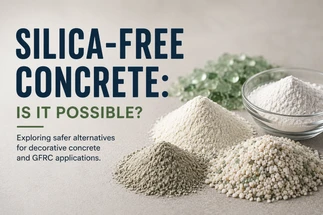
Silica-Free Concrete: Is It Possible? Exploring Safer Alternatives for Decorative Concrete
For decades, silica sand has been a fundamental ingredient in concrete. Its availability, strength, hardness, durability, and particle characteristics make it an excellent aggregate for a wide range of applications. However, growing awareness of crystalline silica exposure and the health risks associated with airborne silica dust has led some manufacturers, researchers, and concrete professionals to explore alternative materials and mix designs.
While traditional silica sand remains the industry standard for many good reasons, interest in recycled materials, sustainability, and workplace safety continues to drive innovation throughout the concrete industry.
This naturally raises the question:
Can concrete be made without crystalline silica?
The answer is yes—at least partially, and in some cases nearly completely—through the use of alternative aggregates, fillers, and supplementary cementitious materials. However, it is important to understand that silica-reduced concrete is not necessarily better than conventional concrete. Rather, it represents another option that may offer advantages in certain applications.
Understanding Crystalline Silica
Crystalline silica is a naturally occurring mineral found in materials such as quartz, sand, granite, sandstone, and many construction products. When these materials are cut, ground, drilled, polished, or otherwise disturbed, fine airborne particles can be released.
Repeated exposure to respirable crystalline silica dust has been linked to serious health conditions including:
• Silicosis
• Chronic obstructive pulmonary disease (COPD)
• Lung cancer
• Kidney disease
Because of these risks, OSHA has implemented strict exposure limits and requirements for controlling silica dust in the workplace.
While hardened concrete itself is generally not considered hazardous, many concrete fabrication operations generate dust during mixing, grinding, polishing, routing, and finishing processes.
Why Consider Silica-Reduced Concrete?
Reducing crystalline silica content can provide several potential benefits:
• Reduced silica dust generation during fabrication
• Easier compliance with workplace dust-control programs
• Increased use of recycled materials
• Reduced reliance on mined aggregates
• Potential sustainability benefits
• New opportunities for specialty mix designs
For decorative concrete fabricators, these benefits can be attractive when producing countertops, furniture, GFRC panels, fireplace surrounds, and architectural precast elements.
However, it is important to recognize that silica-reduced concrete is not intended to replace traditional concrete across the board.
Traditional Silica Sand Still Has Significant Advantages
While alternative aggregates continue to gain interest, silica sand remains one of the most widely used and thoroughly tested aggregates in the concrete industry.
Silica sand offers several advantages:
• Excellent hardness and durability
• Consistent grading and availability
• Proven long-term performance
• Cost effectiveness
• Extensive industry experience and testing data
For many concrete applications, traditional silica sand remains the most practical and economical choice.
The purpose of exploring silica-reduced concrete is not to suggest that conventional concrete is obsolete, but rather to understand emerging materials that may benefit specific applications, sustainability goals, or workplace safety initiatives.
Many of today's highest-performing GFRC, countertop, architectural precast, and decorative concrete systems continue to utilize silica sand successfully. In fact, silica sand remains a key ingredient in countless projects that achieve excellent strength, durability, and long-term performance.
As with most advances in concrete technology, the goal is not necessarily replacement—it is expanding the range of available options.
Alternative Aggregates to Silica Sand
Recycled Glass Aggregate
One of the most promising alternatives to silica sand is recycled glass aggregate.
When crushed and properly graded, recycled glass can function similarly to traditional sand while offering several unique advantages:
• Recycled content
• Consistent particle characteristics
• Light color options
• Decorative appearance
• Reduced reliance on virgin aggregate resources
Proper gradation is critical. A well-graded aggregate contains a balanced distribution of particle sizes that allows smaller particles to fill voids between larger particles. This improves packing density and reduces the amount of cement paste required.
Poorly graded glass can increase water demand, reduce strength, and negatively affect workability.
Understanding Alkali-Silica Reaction (ASR) and Recycled Glass
One concern often raised when discussing recycled glass in concrete is the potential for Alkali-Silica Reaction (ASR).
ASR is a chemical reaction that can occur when reactive silica in aggregates reacts with alkalis present in cement paste in the presence of moisture. Over time, this reaction can create an expansive gel that absorbs water, swells, and may contribute to cracking, map cracking, surface deterioration, and reduced durability.
Because glass contains silica, larger recycled glass particles can be susceptible to ASR under certain conditions.
However, particle size plays a critical role.
Research and industry experience have shown that as glass is ground finer, its behavior changes dramatically. Rather than acting as a reactive aggregate, finely ground glass begins to function as a pozzolan. At sufficiently fine particle sizes, the glass reacts beneficially with calcium hydroxide produced during cement hydration, helping densify the concrete matrix and reducing the potential for harmful ASR.
For this reason, many modern concrete systems use two different approaches:
• Recycled glass aggregate for decorative appearance and aggregate replacement
• Finely ground glass pozzolans for strength enhancement, durability, particle packing, and ASR mitigation
When larger glass aggregates are used, it is generally recommended to incorporate supplementary cementitious materials such as fly ash, slag, metakaolin, or ground-glass pozzolans to help reduce ASR potential.
As with any aggregate system, proper mix design and testing remain essential.
Limestone and Calcium Carbonate Aggregates
Limestone-based aggregates and calcium carbonate sands are widely used throughout the concrete industry and contain little to no crystalline silica.
Benefits include:
• Light color
• Excellent workability
• Improved finishing characteristics
• Reduced silica content
• Compatibility with decorative applications
Ultrafine calcium carbonate fillers can also contribute to improved particle packing and matrix densification, helping create a denser and more refined concrete matrix.
Specialty Mineral Aggregates
Depending on availability and application requirements, other silica-reduced aggregates may include:
• Marble aggregate
• Dolomitic aggregate
• Manufactured mineral fillers
• Specialty ceramic aggregates
Each material should be evaluated for durability, abrasion resistance, strength, and long-term performance.
Ground Glass Pozzolans: More Than Just a Sand Replacement
When recycled glass is ground to an extremely fine particle size, it behaves very differently than aggregate. Finely ground glass can become a highly reactive pozzolan. A pozzolan is a material that reacts with calcium hydroxide produced during cement hydration to form additional cementitious compounds.
Benefits of ground glass pozzolans include:
• Increased long-term strength
• Reduced permeability
• Improved durability
• Improved particle packing
• Reduced shrinkage potential
• Enhanced resistance to ASR when properly formulated
• Reduced cement consumption
Many modern ground-glass pozzolans are manufactured to particle sizes finer than 95% passing a 325-mesh sieve (45 microns), with median particle sizes often in the 10–15 micron range.
At these particle sizes, the enormous surface area contributes to both physical particle packing and chemical pozzolanic activity.
For decorative concrete applications, ground-glass pozzolans such as Bottle Pozz™ offer a practical way to incorporate recycled content while improving particle packing, durability, and long-term performance.
Particle Packing: The Key to High Performance
One of the most important concepts in modern concrete technology is particle packing. Rather than relying solely on cement for strength, high-performance concrete mixes utilize a range of particle sizes that fit together efficiently.
A properly packed system may include:
• Cement
• Ground glass pozzolan
• Ultrafine calcium carbonate
• Fine aggregate
• Coarse aggregate
• Polymers
• Chemical admixtures
As particles pack more tightly, the concrete contains fewer voids, resulting in:
• Higher density
• Lower permeability
• Improved strength
• Reduced shrinkage
• Improved durability
This approach is commonly used in GFRC, ECC, UHPC, and other advanced concrete systems.
Challenges and Trade-Offs of Silica-Reduced Concrete
While silica-reduced concrete systems offer certain advantages, replacing traditional silica sand is not always a direct one-for-one substitution.
Reduced Strength Potential
Some alternative aggregates, particularly softer limestone or calcium carbonate sands, may not contribute the same level of mechanical strength as high-quality silica sand.
While this may not be a concern for many decorative applications, structural or highly loaded elements may require additional testing and optimization.
Increased Water Demand
Certain alternative aggregates may have different particle shapes and surface textures than silica sand. Angular or poorly graded materials can increase water demand, which may:
• Reduce strength
• Increase shrinkage
• Affect finishability
• Increase cracking potential
Workability Changes
When switching to recycled glass or other alternative materials, fabricators may notice changes in:
• Flowability
• Sprayability
• Pumpability
• Troweling characteristics
• Surface appearance
Admixture dosages may need adjustment to achieve the desired performance.
Material Availability
While silica sand is readily available almost everywhere, specialty materials may be more difficult to source depending on location, potentially affecting cost, freight, and lead times.
Additional Testing Requirements
Fabricators transitioning to silica-reduced systems should expect to perform testing for strength, shrinkage, durability, workability, and appearance.
As with any new mix design, real-world testing remains essential.
Building a Silica-Reduced Decorative Concrete System
At Fishstone, we continue to support traditional concrete, GFRC, ECC, and UHPC mix designs while also evaluating emerging materials that may offer benefits in certain applications.
Our goal is to provide fabricators with options and technical information rather than promote a one-size-fits-all solution.
For some projects, traditional silica sand remains the best choice. For others, recycled glass aggregate, ground-glass pozzolans, calcium carbonate fillers, or alternative materials may help achieve specific performance, sustainability, or workplace safety objectives.
Ground Glass Pozzolans
Products such as Bottle Pozz™ can serve as both a highly reactive pozzolan and an ultra-fine particle-packing component.
Advanced Polymers
Acrylic polymers such as KongKrete™ can improve flexural strength, reduce permeability, enhance durability, and improve the performance of thin-section concrete systems such as GFRC.
High-Range Water Reducers
Modern superplasticizers such as P-120™ help reduce water demand while maintaining excellent workability and flow.
Shrinkage and Air Management
Products such as TruCast-SRA™ and TruCast-Defoamer™ can help optimize dimensional stability and surface quality in high-performance decorative concrete mixes.
Putting It All Together
Whether starting with a traditional mix design or a high-performance blend such as HP50™ or UltraCast 360™, successful concrete ultimately comes down to proper material selection, testing, and execution.
Sustainability Benefits
Using recycled glass and alternative mineral fillers can contribute to more sustainable concrete production by:
• Diverting waste glass from landfills
• Reducing virgin aggregate consumption
• Potentially lowering cement requirements
• Supporting circular economy initiatives
Applications for Silica-Reduced Concrete
Silica-reduced concrete systems can be used in:
• Concrete countertops
• GFRC panels
• Fireplace surrounds
• Furniture
• Wall cladding
• Architectural precast
• Decorative castings
• Sculptural concrete
Each application requires careful mix design optimization to achieve the desired balance of workability, strength, weight, and appearance.
Final Thoughts
Traditional silica sand has helped build the modern concrete industry and remains an excellent choice for countless decorative and architectural applications.
Its strength, durability, availability, and long track record make it one of the most trusted aggregates available to concrete professionals.
At the same time, ongoing research into recycled glass aggregates, ground-glass pozzolans, calcium carbonate fillers, and other alternative materials continues to expand the range of options available to fabricators and mix designers.
For most concrete professionals, the decision is not necessarily between traditional concrete and silica-reduced concrete. Instead, it is about understanding the strengths and limitations of each approach and selecting the materials that best fit a project's performance requirements, budget, sustainability goals, and production methods.
Whether using conventional silica sand, alternative aggregates, or a combination of both, successful concrete ultimately comes down to proper material selection, sound mix design principles, testing, and execution.
As new technologies emerge, the most effective approach is often not replacing proven materials, but understanding where new materials may complement existing systems and provide additional options for the future.
Frequently Asked Questions
Can concrete be made completely without crystalline silica?
In some specialized applications, yes. However, many concrete materials naturally contain trace amounts of silica. Most practical approaches focus on reducing crystalline silica rather than eliminating it entirely.
Should I stop using silica sand in my concrete mixes?
Not necessarily. Silica sand remains one of the most widely used and proven aggregates in the concrete industry. While silica-reduced concrete systems may offer benefits in certain situations, traditional silica sand continues to provide excellent performance, durability, workability, and value for many decorative concrete applications.
Is recycled glass stronger than sand in concrete?
Not necessarily. Strength depends on the overall mix design, aggregate grading, water-cement ratio, and admixture package. Properly graded recycled glass can perform very well in many applications.
Does ground glass cause alkali-silica reaction (ASR)?
Larger glass particles can contribute to ASR under certain conditions. However, when glass is ground to a sufficiently fine particle size, it behaves as a pozzolan rather than a reactive aggregate. Finely ground glass pozzolans are commonly used to improve durability and help mitigate ASR in properly designed concrete mixtures.
Can GFRC be made without silica sand?
Yes. Alternative aggregate systems using recycled glass, calcium carbonate, or other specialty fillers can be used in GFRC formulations.
What is the benefit of ground glass pozzolan?
Ground glass pozzolans improve particle packing, contribute pozzolanic activity, increase durability, reduce permeability, and can help produce stronger and denser concrete.
Are silica-reduced concrete mixes suitable for countertops?
Yes. Many countertop fabricators are exploring silica-reduced formulations that utilize recycled glass aggregate, ground glass pozzolans, and calcium carbonate fillers while maintaining excellent appearance and performance.